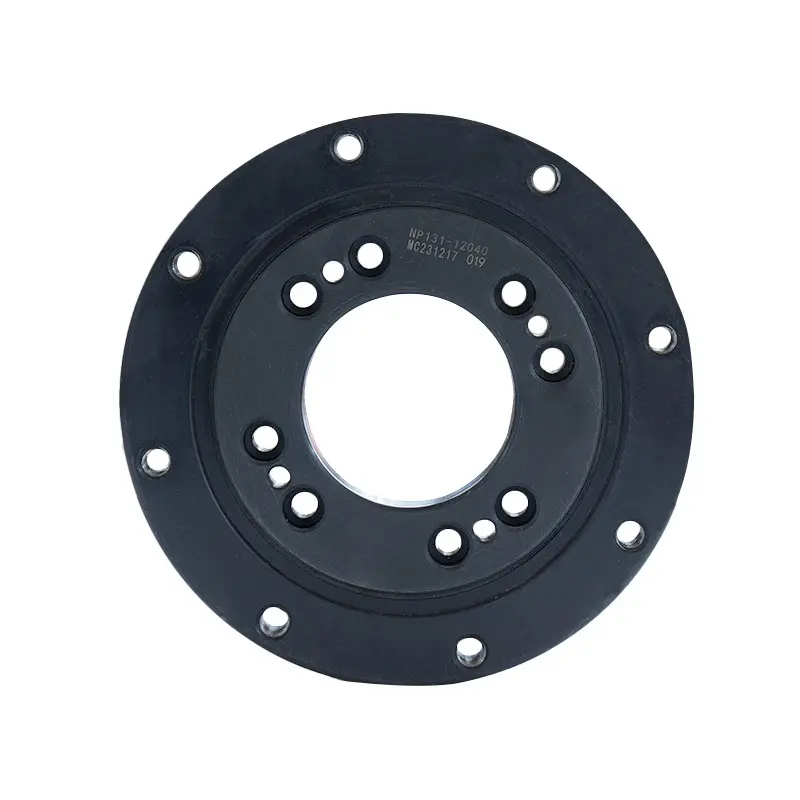
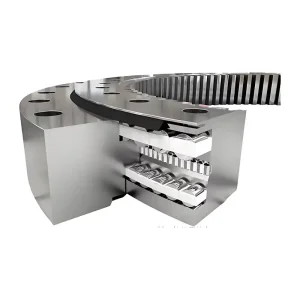
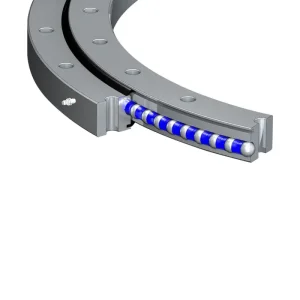
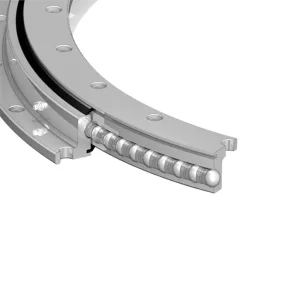
The single-row crossed roller slewing bearing adopts cylindrical rollers to provide line contact, whose load-carrying capacity is far higher than that of ball bearings with point contact of the same size. The roller axes are arranged in an "X-cross" pattern inside the bearing. Half of the rollers bear axial forces, while the other half (crossed with them) bear radial forces; however, they form an integrated unit and work in coordination. This structure not only improves the load-carrying capacity of the bearing, but also enhances the operational stability of the equipment.
The raceways usually adopt a "V-shape" or "flat surface + rib" design. One raceway surface is used to withstand axial loads, and the other vertical surface is used to withstand radial loads. The precise fit between the rollers and raceways ensures high precision and stability during slewing operations. The inner and outer rings are usually of integral or split type, featuring a more compact structure.
With a flexible mounting design, the single-row crossed roller slewing bearing can meet the diverse needs of users, and can be easily installed either horizontally or vertically.
 Manchen Transmission