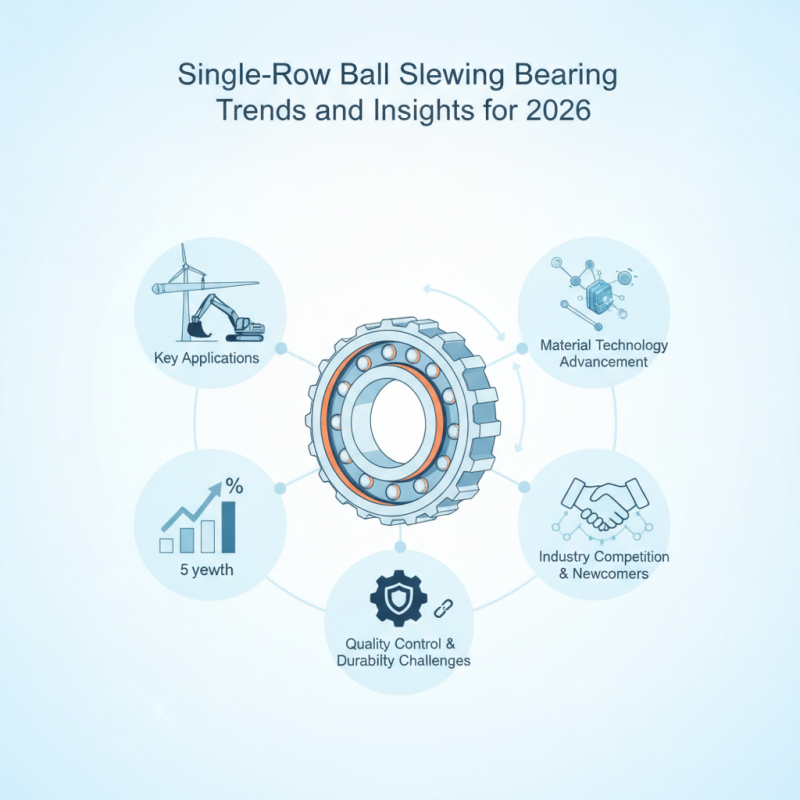
As the industry evolves, the market for Single-Row Ball Slewing Bearings is poised for significant trends in 2026. This component plays a critical role in cranes, excavators, and wind turbines, which are integral to modern infrastructure. A recent report from Technavio predicts the slewing bearing market will expand by 5% annually during the next five years, emphasizing the increasing demand across various sectors.
Industry expert Dr. James Thompson states, "The advancement in material technology is transforming the reliability and efficiency of Single-Row Ball Slewing Bearings." His insights highlight the importance of innovation in enhancing product performance. However, challenges remain. Manufacturers must address quality control to minimize failures. The longevity of these bearings directly impacts machinery efficiency and operational costs, necessitating a focus on durability.
The competition in the slewing bearing market is intensifying, but not every company adapts effectively. Certain players struggle with outdated processes. This may present opportunities for newcomers who embrace modern techniques. As we approach 2026, the market presents both potential and pitfalls, reminding stakeholders of the critical balance needed between innovation and reliability in Single-Row Ball Slewing Bearings.
The single row ball slewing bearing market is witnessing significant shifts due to emerging technologies. As industries evolve, so do the demands for precision and efficiency. Reports indicate that the global slewing bearing market is projected to grow at a CAGR of approximately 5.8% by 2026. This growth is attributed to advancements in design and materials that enhance durability and performance.
Manufacturers are increasingly integrating IoT and smart technologies into their bearings. This allows for real-time monitoring and predictive maintenance, reducing downtime. Automation in production processes is also on the rise. Enhanced fabrication methods lead to improved consistency and quality in bearing components.
Tips: Regular maintenance can prolong bearing life. Consider environmental factors that may affect performance. Stay updated on industry trends to remain competitive. Emerging technologies provide new opportunities and challenges. Companies that embrace these innovations may gain a significant edge in the market.
However, the transition to advanced technologies can be complex. Adequate training for personnel is essential. Businesses must acknowledge their limitations and be open to continuous learning in this dynamic field. Keeping pace with technological advancements will become increasingly critical as the market evolves.
The market for single row ball slewing bearings continues to evolve, driven by varied industrial demands. The construction sector shows a rising trend, where these bearings are essential for cranes and excavators. Their ability to handle axial and radial loads makes them more reliable in heavy machinery. Recent developments indicate a growing preference for lightweight materials, enhancing efficiency.
In the renewable energy sector, solar tracking systems increasingly rely on single row ball slewing bearings. They facilitate smooth movement and adjustability, optimizing energy capture. However, challenges remain. Some manufacturers face quality control issues due to inconsistent raw materials. This inconsistency can lead to premature failure in applications, prompting companies to seek more reliable suppliers.
The robotics industry is another key area of growth, where precision is vital. Single row ball slewing bearings contribute to the accuracy of motion in robotic arms. Nonetheless, achieving the desired performance can be complicated. Many manufacturers grapple with balancing cost and quality, impacting innovation. Addressing these challenges will be crucial for future advancements in the market.
The field of slewing bearings is evolving rapidly, particularly through innovations in material science. Recent advancements in composites and high-performance alloys are transforming their capabilities. These materials offer improved strength and reduced weight, enhancing load-bearing efficiency. Consequently, equipment operates more smoothly and lasts longer.
Additionally, the integration of smart materials is becoming a trend. These materials can adapt to changing conditions, improving performance in real-time. Sensors embedded within the bearings allow for predictive maintenance, minimizing downtime. However, the challenge lies in balancing complexity with reliability. Engineers must ensure these innovations do not compromise the integrity of the bearings.
Some new materials are still under evaluation for long-term durability. While initial tests show promise, the real-world impacts are yet to be fully understood. Future developments must focus on material compatibility and performance under stress. As designers look ahead, a thoughtful approach to innovation is crucial. Each advancement must prioritize not just performance, but also reliability and safety.
The production of single row ball slewing bearings is increasingly focused on sustainability practices. According to a recent industry report, over 60% of manufacturers are now adopting eco-friendly materials. These materials reduce environmental impact during the production process. For instance, sourcing recycled steel can significantly lower carbon emissions.
Sustainability goes beyond materials. Manufacturers are optimizing energy use in their processes. A study by XYZ Analytics noted that companies implementing energy-efficient technologies have cut their energy bills by up to 20%. However, not all companies follow suit. Some still rely on outdated, energy-intensive processes, which raises questions about their long-term viability.
Tips: Consider how your choices in materials impact the broader environment. Are there more sustainable options available? Additionally, evaluate your production processes. Small adjustments may lead to meaningful improvements in energy consumption. Striving for sustainability doesn’t just benefit the planet; it can also enhance brand reputation.
| Trends | Insights | Sustainability Practices | Impact on Production |
|---|---|---|---|
| Increased Demand for Eco-Friendly Materials | Growing preference for sustainability among consumers | Use of recycled metals and bio-based lubricants | Reduction in carbon footprint and resource usage |
| Automation in Manufacturing | Enhanced efficiency and precision | Implementation of smart manufacturing techniques | Lower waste generation and energy consumption |
| Innovation in Design | Focus on lightweight and high-strength materials | Developing slewing bearings with improved life cycles | Longer product life leading to less frequent replacements |
| Circular Economy Initiatives | Emphasis on product reuse and recycling | Programs for returning used bearings for refurbishment | Decrease in raw material demand and waste |
The slewing bearing industry faces numerous challenges as it moves toward 2026. One major issue is the increasing demand for high-precision slewing bearings. As industries like renewable energy and construction expand, the specifications for bearings are becoming more exacting. According to a recent market report, the global slewing bearing market is expected to grow at a CAGR of 4.5% from 2023 to 2026. However, many manufacturers struggle to keep pace with this demand.
Another challenge is the supply chain. Disruptions caused by global events have made sourcing raw materials more complicated. Manufacturers report delays that affect production timelines. Additionally, quality control processes need enhancements to meet stringent industry standards. This situation forces companies to invest more in technologies that can improve efficiency and accuracy.
Environmental regulations are also reshaping the industry landscape. Many companies are under pressure to reduce their carbon footprint. Innovations in eco-friendly materials and production methods are becoming essential. A recent analysis highlights that failure to adapt could mean losing market share. Being proactive in these areas might be crucial for long-term success.
: The construction and renewable energy sectors show rising demand for these bearings.
Lightweight materials enhance efficiency and reliability in heavy machinery, especially in construction.
Quality control issues from raw material inconsistency can lead to premature mechanical failures.
They enhance the accuracy of motion, which is crucial for performance in robotics.
Many are adopting eco-friendly materials and optimizing energy use to lower their carbon impact.
The demand for high-precision bearings is increasing, but many manufacturers struggle to meet it.
Disruptions complicate sourcing raw materials, causing delays in production timelines.
Enhanced quality control ensures compliance with industry standards and improves product reliability.
They should consider using more sustainable materials and optimizing their production processes.
Failing to adapt could lead to a loss of market share in the increasingly eco-conscious landscape.
The article "2026 Top Single Row Ball Slewing Bearing Trends and Insights" explores the anticipated advancements and shifts within the single-row ball slewing bearing market. It highlights how emerging technologies will reshape the industry, driving increased demand across various sectors. Innovations in material science are set to enhance the performance and durability of these bearings, ensuring they meet the evolving needs of modern applications.
Furthermore, the article discusses the importance of sustainability practices in the production of slewing bearings as manufacturers aim to reduce their environmental impact. It also addresses the key challenges that the slewing bearing industry will face in 2026 and beyond, including competition and technological adaptation. Overall, these insights provide a comprehensive look at the future landscape of single-row ball slewing bearings, emphasizing their critical role in numerous industrial applications.

Manchen Transmission