Why Choose Single-Row Ball Slewing Bearings for Your Projects?

Time:2026-06-08 Author:Charlotte
0%

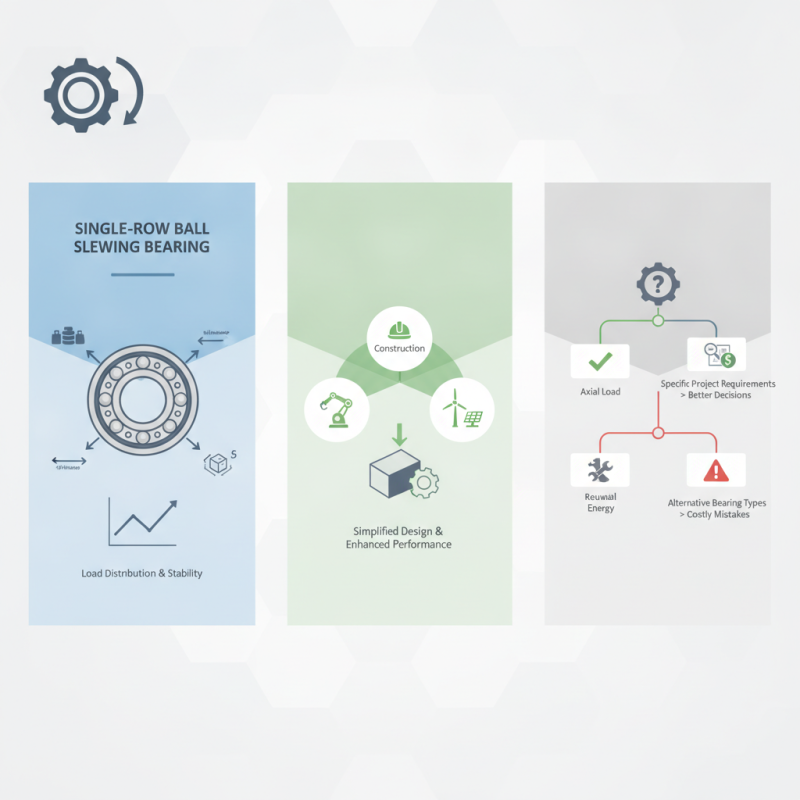
Single-Row Ball Slewing Bearings play a crucial role in various engineering applications. According to Dr. Emily Chen, a renowned expert in mechanical engineering, "The efficiency of your project often hinges on the right bearing choice." This highlights the importance of understanding the benefits and applications of Single-Row Ball Slewing Bearings.

These bearings excel in load distribution and stability. They are designed to handle axial, radial, and tilting moment loads simultaneously, making them versatile and reliable. Industries such as construction, robotics, and renewable energy benefit from their unique attributes. These bearings can simplify design while enhancing performance.

Yet, it's essential to consider that not all projects require Single-Row Ball Slewing Bearings. Sometimes, alternative bearing types might be more suitable. Careful evaluation is necessary to avoid costly mistakes. Understanding specific project requirements will lead to better decisions and outcomes.
Why Choose Single-Row Ball Slewing Bearings for Your Projects?

Importance of Single-Row Ball Slewing Bearings in Modern Engineering

Single-row ball slewing bearings play a critical role in modern engineering and manufacturing. Their design allows for high load capacity and precise movement, making them essential for various applications. According to a recent industry report, the global demand for these bearings is expected to grow by 5.4% annually, reflecting their significance in heavy machinery and construction sectors.

These bearings are compact yet robust. They can effectively manage axial, radial, and moment loads. Engineers appreciate their versatility. In cranes and excavators, for example, they enable smooth rotations under heavy loads. A focus on weight and dimension also sheds light on their efficiency. Their lightweight design often leads to energy savings and better performance.

However, it's important to consider potential challenges. Installation errors can lead to misalignment. This affects performance and longevity. Regular maintenance is crucial to ensure their reliability. Despite their advantages, end-users must remain vigilant about the operating environment and load specifications to maximize performance. Balancing these factors is key to harnessing the full potential of single-row ball slewing bearings.

Key Advantages of Using Single-Row Ball Slewing Bearings

Single-row ball slewing bearings are gaining popularity in various engineering and construction applications. They stand out due to their compact design and ease of installation. These bearings support axial, radial, and moment loads simultaneously, making them versatile. According to industry reports, the global slewing bearing market is expected to reach USD 4.02 billion by 2026, indicating a steady growth due to their increasing adoption across sectors.

One significant advantage of single-row ball slewing bearings is their relatively low weight compared to other bearing types. This characteristic allows for easier handling and installation during projects. Furthermore, their design reduces friction, which extends the lifecycle of the equipment. A study published by the International Journal of Engineering Research estimates that using these bearings can enhance efficiency by up to 25% in certain applications. However, improper selection and maintenance can lead to challenges, such as increased wear and reduced performance.

Additionally, their reliability plays a key role in project success. These bearings can function in harsh environments, which is crucial for projects in construction and heavy machinery. However, it's vital to conduct proper inspections regularly. Ignoring this aspect can lead to catastrophic failures. The balance between performance and maintenance is essential for ensuring operational continuity. Regular analysis of wear patterns can help maintain their integrity, ensuring that they meet project demands effectively.

Comparison of Single-Row and Multi-Row Slewing Bearings Performance

When considering slewing bearings, the choice between single-row and multi-row designs often comes down to application specifics and performance needs. Single-row ball slewing bearings are lighter and more compact. They generally require less installation space, making them ideal for projects with tight constraints. Their simplicity can lead to easier maintenance and lower production costs.

On the other hand, multi-row slewing bearings offer increased load capacity. They are better suited for heavy-duty applications. However, they tend to be bulkier and may involve complex installation procedures. This added complexity could result in higher long-term maintenance needs.

It's crucial to evaluate the load conditions and space limitations of your project. While single-row bearings excel in lighter applications, their performance may diminish under excessive loads. Conversely, multi-row designs could be over-engineered for lighter tasks, leading to unnecessary costs and weight. Each option has trade-offs that must align with project requirements.

Why Choose Single-Row Ball Slewing Bearings for Your Projects? - Comparison of Single-Row and Multi-Row Slewing Bearings Performance

Performance Metric Single-Row Ball Slewing Bearings Multi-Row Slewing Bearings
Load Capacity Moderate High
Rotational Speed High Moderate
Installation Space Compact More Space Required
Maintenance Ease Easy Moderate
Cost-Effectiveness High Moderate

Application Areas and Industry Standards for Single-Row Ball Slewing Bearings

Single-row ball slewing bearings are crucial in various industries. They offer high radial and axial load capacities. Common applications include cranes, excavators, and solar energy equipment. These bearings are designed to handle heavy loads while allowing smooth rotation. They often find use in construction and renewable energy projects, where precision and reliability are essential.

The industry standards for single-row ball slewing bearings ensure quality and performance. These standards address the design, manufacturing, and testing processes. Compliance with these guidelines guarantees that the bearings can withstand demanding conditions. It's essential to choose components that meet the specific requirements of your project. The wrong selection can lead to inefficiencies and increased maintenance costs.

Some users may overlook the importance of compatibility. Using a bearing that doesn’t match other components can lead to failures. Regular maintenance is also often underestimated. Neglecting this can significantly reduce the lifespan of your assembly. These factors highlight the balance needed between quality and proper implementation in any project.

Financial Efficiency: Cost-Benefit Analysis of Single-Row Slewing Bearings

Single-row ball slewing bearings are increasingly favored for various engineering projects. One significant reason for this preference is their financial efficiency. A comparative cost-benefit analysis shows that these bearings often present lower initial costs without sacrificing performance. Reports indicate that projects utilizing these bearings can save up to 30% in operational costs over their lifespan. This is crucial when working within tight budgets.

Analyzing maintenance expenses is also essential. Single-row slewing bearings typically require less maintenance than multi-row alternatives. Industry data suggest decreasing routine maintenance needs by approximately 20%, translating to savings in labor and downtime. Projects can allocate these resources to other critical areas, enhancing overall productivity. However, it's necessary to evaluate the specific requirements of each application. Sometimes, the simplification provided by single-row ball bearings may lead to limitations under certain load conditions.

Lifecycle analysis reveals that these bearings exhibit excellent durability when designed for typical load ratings. High-quality single-row slewing bearings often last longer than anticipated, reinforcing their cost-effectiveness. Yet, companies should remain cautious. Not all applications suit single-row bearings perfectly. A thorough understanding of the load and stress factors is vital for a successful selection.

FAQS

: What are single-row ball slewing bearings used for?

: They are popular in engineering and construction applications due to their compact design and versatility.

Why are single-row ball slewing bearings lightweight?

Their low weight allows for easier handling and installation during projects, enhancing efficiency.

How do these bearings affect operational efficiency?

They can increase efficiency by up to 25% in certain applications, according to industry studies.

What role does reliability play in slewing bearings?

Reliability is crucial for project success, especially in harsh environments typical in construction.

What maintenance is required for these bearings?

Regular inspections are vital to avoid increased wear and ensure proper performance.

How do single-row ball slewing bearings save costs?

They have lower initial costs and can reduce operational costs by up to 30% over their lifespan.

How often do these bearings need maintenance?

They generally require less maintenance, about 20% less than multi-row alternatives.

Are single-row ball slewing bearings suitable for all applications?

No, some applications may not suit them. Understanding load conditions is crucial.

What happens if inspections are ignored?

Ignoring inspections can lead to catastrophic failures, impacting project timelines and costs.

Can single-row bearings handle high loads?

While they can handle many loads, not all applications are ideal. Careful evaluation is needed.

Conclusion

Single-Row Ball Slewing Bearings play a crucial role in modern engineering applications due to their compact design and efficiency in load distribution. These bearings offer significant advantages, including enhanced stability, precision, and the ability to handle radial and axial loads simultaneously, making them ideal for various mechanical systems. A comparison between single-row and multi-row slewing bearings highlights that the former often delivers superior performance in space-constrained environments while maintaining lower weight.

In addition to their technical benefits, Single-Row Ball Slewing Bearings are widely applied across multiple industries, adhering to rigorous industry standards. Their financial efficiency is evident through a comprehensive cost-benefit analysis, which demonstrates how these bearings deliver long-term savings and reliability. Overall, the integration of Single-Row Ball Slewing Bearings into engineering projects not only optimizes functionality but also contributes to improved economic outcomes.


Charlotte

Charlotte

Charlotte is a seasoned marketing professional with a deep understanding of the company's portfolio and a passion for elevating its presence in the market. With a keen eye for detail and a commitment to excellence, she ensures that our professional blog is regularly updated with insightful articles......